Electrodeionization (EDI)
Deionizing reverse osmosis (RO) permeate with DC current.
Cost-effective, reliable, chemical-free permeate polishing
Electrodeionization (EDI) is a continuous, chemical-free process of removing ionized and ionizable species from feedwater using DC power. EDI is typically used to polish reverse osmosis (RO) permeate, and is a smart alternative to — and effective replacement of — conventional mixed bed ion exchange (IX).Using electrodeionization eliminates the need to store and handle the hazardous chemicals used for resin regeneration in mixed beds. And since electricity is EDI’s only consumable, this method of permeate polishing does not produce a hazardous waste stream.
Our proven, patented EDI modules can optimize performance, maintain continuous product quality, and produce high-purity water, with high contaminate-ion rejection.
Learn more about ion exchange technology.
DuPont Webinar Program Join our online learning and thought leadership program used by over 30,000 water industry professionals.FAQs Get quick answers to technical questions in our resource center.Electrodeionization (EDI) details
A closer look
What Is EDI? EDI for Water Treatment Polishing RO Permeate
Electrolysis, electrodialysis, and electrodeionization
Electrolysis involves the passage of an electrical current through an electrolyte solution, with the subsequent movement of positively and negatively charged to negative and positive electrodes. This process effectively splits water molecules, and is the driving force of electrodeionization. Electrodialysis then separates the hydroxal (OH-) and hydrogen (H+) ions from the electrolyte solution, while electrodeionization overcomes the limits of electrodialysis, allowing for ion separation without increasingly higher voltage.
The fundamental process is this: Imagine a simple model of a battery connected to two electrodes immersed in a saltwater bath. When charge is introduced on the electrodes, a reduction reaction involving the water molecules occurs at the cathode: hydrogen gas is released and OH- ions are left behind. At the anode, oxygen gas is released and H+ ions are left behind in an oxidation reaction. The presence of salt in the solution facilitates continuous reactions at the electrodes, drawing hydroxyl ions from the cathode and hydrogen ions from the anode.
In electrodialysis, electrical current drives ions across a semipermeable membrane. In an EDI system, a membrane that allows for the passage of cations (OH- ions) only is positioned next to the cathode, and a membrane permeate to anions (H+ ions) only is positioned next to the anode. A central chamber now contains the saline solution. When the electrical charge is applied to the system and the chemical reactions occur, the ions will move across the membranes out of the central chamber to their respective electrodes, leaving behind the constituents of the salt molecules and any other impurities.
Electrodialysis is limited, however. As the water becomes purer, the system’s voltage requirement increases — even exceeding 600 volts — which can cause arching. Electrodeionization resolves this challenge by introducing ion exchange (IX) resins, or ionically conductive media, into the central chamber. This allows the ions to easily migrate out of the central, dilute chamber without high voltage.
Using DuPont™ EDI modules
When installed as part of a water-treatment system, electrodeionization modules from DuPont Water Solutions use electrical current to force a continuous migration of contaminant ions out of the feedwater and into the reject or concentrate stream, while continuously regenerating the ion exchange (IX) resin bed with H+ and OH- ions that are derived from water splitting.
Feedwater (the dilute stream) enters from the bottom of the DuPont™ EDI module and is diverted into vertically spiraled cells known as dilute chambers. The dilute streams flow vertically through ion exchange resins located between the anion and cation membranes.
Concentrate enters the bottom of the module through the center pipe and is diverted into spirally flowing cells known as concentrate chambers. DC current is applied across the cells, splitting a small percentage of water molecules into H+ and OH- ions. Drawn to their respective electrodes, the H+ and OH- ions first migrate through their respective resins, continuously regenerating the resin, then through their respective permeable membranes and into the concentrate chambers. Contaminate ions dissolved in the feedwater then attach to their respective ion exchange resins, displacing H+ and OH- ions. Once within the resin bed, the ions join in the migration of other ions and permeate the membrane into the concentrate chambers. The contaminant ions are trapped in the contaminant chambers and are recirculated and bled out of the system.
The feedwater continues to pass through the dilute chamber, is purified and collected on the outlet of the dilute chambers, and then exits the DuPont™ EDI module.
Conversion of carbonic and silicic acids
Electrodeionization is an effective means of polishing reverse osmosis (RO) permeate. When the permeate water enter the EDI system with the electric current applied, some of the permeate flows through the dilute chamber, where most of the cation and anions are removed. As the water become purer, the voltage differential begins to exceed 2 volts, splitting the water molecules. This creates localized areas of low pH (with H+ ions) and high pH (with OH- ions). In the areas of high pH, carbonic acid can convert to the anion bicarbonate and silicic acid to the anion bisilicate, which EDI can remove.
-
What Is EDI?+
Electrolysis, electrodialysis, and electrodeionization
Electrolysis involves the passage of an electrical current through an electrolyte solution, with the subsequent movement of positively and negatively charged to negative and positive electrodes. This process effectively splits water molecules, and is the driving force of electrodeionization. Electrodialysis then separates the hydroxal (OH-) and hydrogen (H+) ions from the electrolyte solution, while electrodeionization overcomes the limits of electrodialysis, allowing for ion separation without increasingly higher voltage.
The fundamental process is this: Imagine a simple model of a battery connected to two electrodes immersed in a saltwater bath. When charge is introduced on the electrodes, a reduction reaction involving the water molecules occurs at the cathode: hydrogen gas is released and OH- ions are left behind. At the anode, oxygen gas is released and H+ ions are left behind in an oxidation reaction. The presence of salt in the solution facilitates continuous reactions at the electrodes, drawing hydroxyl ions from the cathode and hydrogen ions from the anode.
In electrodialysis, electrical current drives ions across a semipermeable membrane. In an EDI system, a membrane that allows for the passage of cations (OH- ions) only is positioned next to the cathode, and a membrane permeate to anions (H+ ions) only is positioned next to the anode. A central chamber now contains the saline solution. When the electrical charge is applied to the system and the chemical reactions occur, the ions will move across the membranes out of the central chamber to their respective electrodes, leaving behind the constituents of the salt molecules and any other impurities.
Electrodialysis is limited, however. As the water becomes purer, the system’s voltage requirement increases — even exceeding 600 volts — which can cause arching. Electrodeionization resolves this challenge by introducing ion exchange (IX) resins, or ionically conductive media, into the central chamber. This allows the ions to easily migrate out of the central, dilute chamber without high voltage.
-
EDI for Water Treatment+
Using DuPont™ EDI modules
When installed as part of a water-treatment system, electrodeionization modules from DuPont Water Solutions use electrical current to force a continuous migration of contaminant ions out of the feedwater and into the reject or concentrate stream, while continuously regenerating the ion exchange (IX) resin bed with H+ and OH- ions that are derived from water splitting.
Feedwater (the dilute stream) enters from the bottom of the DuPont™ EDI module and is diverted into vertically spiraled cells known as dilute chambers. The dilute streams flow vertically through ion exchange resins located between the anion and cation membranes.
Concentrate enters the bottom of the module through the center pipe and is diverted into spirally flowing cells known as concentrate chambers. DC current is applied across the cells, splitting a small percentage of water molecules into H+ and OH- ions. Drawn to their respective electrodes, the H+ and OH- ions first migrate through their respective resins, continuously regenerating the resin, then through their respective permeable membranes and into the concentrate chambers. Contaminate ions dissolved in the feedwater then attach to their respective ion exchange resins, displacing H+ and OH- ions. Once within the resin bed, the ions join in the migration of other ions and permeate the membrane into the concentrate chambers. The contaminant ions are trapped in the contaminant chambers and are recirculated and bled out of the system.
The feedwater continues to pass through the dilute chamber, is purified and collected on the outlet of the dilute chambers, and then exits the DuPont™ EDI module.
-
Polishing RO Permeate+
Conversion of carbonic and silicic acids
Electrodeionization is an effective means of polishing reverse osmosis (RO) permeate. When the permeate water enter the EDI system with the electric current applied, some of the permeate flows through the dilute chamber, where most of the cation and anions are removed. As the water become purer, the voltage differential begins to exceed 2 volts, splitting the water molecules. This creates localized areas of low pH (with H+ ions) and high pH (with OH- ions). In the areas of high pH, carbonic acid can convert to the anion bicarbonate and silicic acid to the anion bisilicate, which EDI can remove.
Our approach to electrodeionization
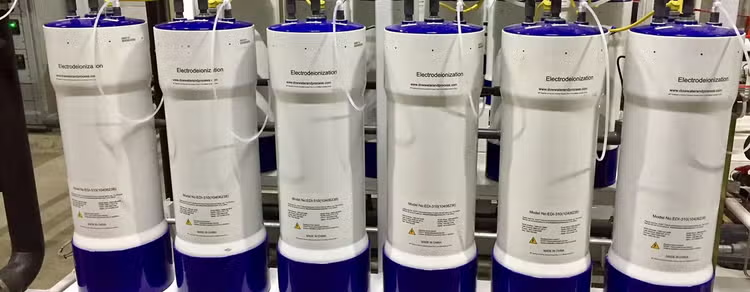
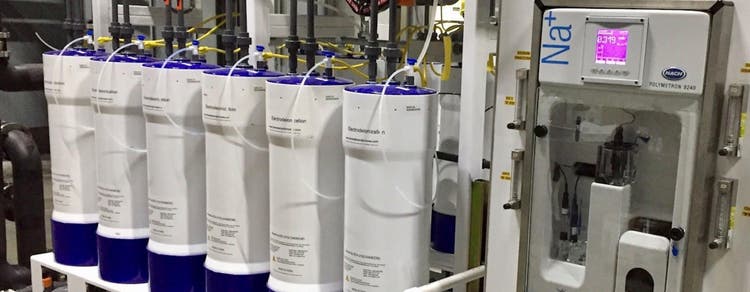
The DuPont™ EDI module utilizes a unique spiral wound design containing membrane and ion exchange resins, sealed in a high-strength fiberglass reinforced plastic (FRP) pressure vessel. The patented flow process of the dilute and concentrate streams make DuPont™ EDI modules completely unique. DuPont™ EDI modules optimize performance, maintain continuous product quality and can produce up to 18 MΩ-cm high-purity water, with high silica and boron rejection.
The advantages of the DuPont™ EDI module, especially used with two-pass reverse osmosis (RO), include:
- No leakage: The DuPont™ EDI module is reliably sealed with high-pressure top and bottom end caps, eliminating leakage problems commonly associated with plate and frame designs.
- Quality control: Each DuPont™ EDI module is performance and pressure tested prior to leaving our factory to ensure trouble-free start-up and operation.
- Low maintenance: Unlike plate and frame EDI systems, DuPont™ EDI modules do not require tightening of nuts and bolts at installation or the retorquing of bolts on an ongoing basis to prevent leaks.
- Light-weight modules, modular, easy- access designs: The DuPont™ EDI modules result in very modular systems that allow easy access, and the light-weight modules are easy to work with; no special lifting devices are required. Each module comes complete with an individual dilute product water sample port.
- Cost effectiveness: The spiral wound DuPont™ EDI modules allow system integrators to build systems that have both lower capital and operating costs when compared to plate and frame EDI devices and are truly a cost-effective replacement for conventional mixed bed ion exchange.
Find electrodeionization products
View a list of our industry-leading electrodeionization products.
Related industries
Our technologies provide premium solutions for a broad range of industries. Learn more about the markets that depend on electrodeionization technology.

We help commercial enterprises and facilities operate efficiently and offer highquality products with our water-treatment solutions.
Learn more

We help everyone’s favorite foods and beverages taste better with advanced separations of sugars, dairy streams, and other nutritional ingredient.
Learn more
Our technologies and solutions are designed to help you overcome water challenges to produce your desired quantity and quality of industrial utility water.
Read more
We develop best-in-class technologies, accompanied by an advanced product portfolio of solutions, to address your crucial wastewater challenges.
Read more
We enable the production of some of today’s most popular technologies by facilitating ultrapure water and effective water reuse.
Learn more
We help energy companies improve operational efficiency with specialized water treatment and wastewater reuse.
Learn more

We enable the smooth and safe operation of power plants through innovative water treatment and wastewater reuse.


Related resources
View by: View all resources ✕ ✕ To access secured content from DuPont Please Sign In or Sign Up below Sign In New User ? Sign Up
See what’s possible
Ask us how electrodeionization can help you produce high-quality water while optimizing both performance and product quality.