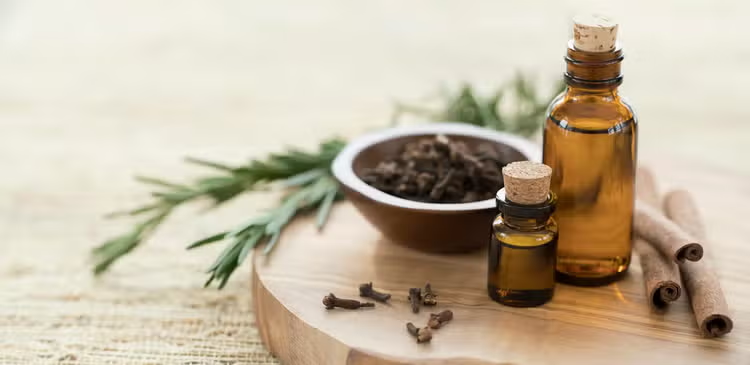
Purification of Plant and Animal Extracts
DuPont™ AmberLite™ adsorption resins and ion exchange resins for isolating, purifying, and concentrating polyphenols, alkaloids, and heparin.
Visit our e-store for your early-stage research and discovery projects
Warning !
The link you are about to click is opening an external website which is not owned by DuPont. This website may collect data or solicit personal information from you. Please note that we do not control this website and are not responsible for its content, privacy policies or for the collection, use or disclosure of any information this site may collect.
Purify, isolate, and concentrate plant and animal extracts
The natural world is a rich source of medicinal compounds. Many plants contain polyphenols, which have positive effects on cardiovascular health and inflammatory processes. Flavonoids and anthocyanins, subclasses of polyphenols, are commonly found in fruits and vegetables and are known for antioxidant properties. Tocopherols (Vitamin E) are a family of fat-soluble phenols that come from vegetables oils.
Citrus fruits, teas, and herbs, which are sources of terpenoids, have long been the source of folk remedies. Terpene extracts are now under investigation as anti-inflammatory agents. Morphine and ephedrine are alkaloid drugs made from plants. Morphine comes from the poppy plant and ephedrine comes from the ephedra vulgaris (Ma Huang) herb. Heparin, extracted from pigs, is one of the most well-known of the animal-derived drugs.
Many industrial processes for pharmaceuticals and nutritional supplements still rely on natural extraction processes today. These extraction process rely on cooking, boiling, or solvent extraction of the active compounds from the original plant or animal tissue. The resulting liquid phase is a dilute mixture that includes not only the target compound but also a variety of impurities. DuPont™ AmberLite™ adsorption resins and ion exchange resins can help you to purify your product and make it easier to handle.
DuPont Resins for Downstream Drug Purification
Learn more about DuPont’s resin portfolio for bioprocessing applications.
DuPont Resins for Heparin Extraction
Learn how DuPont™ AmberLite™ FPA98 Cl Ion Exchange Resins enable crude and fine heparin extraction.
View all product data sheets for our Plant & Animal Extract products.
Purification solutions for medicines and nutraceuticals
Learn more about the multiple ways DuPont’s ion exchange resins and polymer adsorbent resins can help you with your purification challenges. Capture-Concentrate: Plant Extracts Capture-Concentrate: Animal Extracts
Purification of plant extracts with DuPont™ AmberLite™ XAD™ adsorbent resins
The plant extraction process produces a complex mixture with many plant compounds in it. DuPont™ AmberLite™ XAD™ resins can be used to capture the target species. Once the resin absorbs the target molecule and the impurities are flushed from the system, the product is released from the resin with a solvent change. This can result in a purer, more concentrated plant extract, as the product concentration is reset during the elution step.
AmberLite™ XAD™ resins are robust and can be used for many cycles with proper regeneration and cleaning, proving a cost-effective way to purify plant extracts. There are many different types of resins available, each with its own pore size and volume. This allows users to choose the resin that will best suit their needs for purifying plant extracts.
View all products for capture-concentrate in our product finder.
Purification of animal extracts
Like plant extracts, animal extracts contain many species that must be removed before a final product is ready. Purification of animal extracts is complex, usually requiring many purification and fractionation steps. Often, species are removed based on salt formation or ion type. One such case is the purification of heparin.
Heparin is an anticoagulant that prevents blood clots caused by surgeries or medical conditions. It is a highly charged polysaccharide with sulfate functional groups, sourced primarily from pigs. DuPont™ AmberLite™ anion exchange resins can be used to capture and concentrate dilute heparin after digestion or to fractionate heparin species based on charge density.
View all products for capture-concentrate in our product finder.
-
Capture-Concentrate: Plant Extracts+
Purification of plant extracts with DuPont™ AmberLite™ XAD™ adsorbent resins
The plant extraction process produces a complex mixture with many plant compounds in it. DuPont™ AmberLite™ XAD™ resins can be used to capture the target species. Once the resin absorbs the target molecule and the impurities are flushed from the system, the product is released from the resin with a solvent change. This can result in a purer, more concentrated plant extract, as the product concentration is reset during the elution step.
AmberLite™ XAD™ resins are robust and can be used for many cycles with proper regeneration and cleaning, proving a cost-effective way to purify plant extracts. There are many different types of resins available, each with its own pore size and volume. This allows users to choose the resin that will best suit their needs for purifying plant extracts.
View all products for capture-concentrate in our product finder.
-
Capture-Concentrate: Animal Extracts+
Purification of animal extracts
Like plant extracts, animal extracts contain many species that must be removed before a final product is ready. Purification of animal extracts is complex, usually requiring many purification and fractionation steps. Often, species are removed based on salt formation or ion type. One such case is the purification of heparin.
Heparin is an anticoagulant that prevents blood clots caused by surgeries or medical conditions. It is a highly charged polysaccharide with sulfate functional groups, sourced primarily from pigs. DuPont™ AmberLite™ anion exchange resins can be used to capture and concentrate dilute heparin after digestion or to fractionate heparin species based on charge density.
View all products for capture-concentrate in our product finder.
Select publications using our products for plant & animal extracts
Zhao, X., Zhang, S.S., Zhang, X.K., He, F., & Duan, C.Q. (2020). An effective method for the semi-preparative isolation of high-purity anthocyanin monomers from grape pomace. Food Chemistry, 310, 125830. https://doi.org/10.1016/j.foodchem.2019.125830
Esteves, T., Mota, A.T., Barbeitos, C., Andrade, K., Afonso, C.A.M., & Ferreira, F.C. (2020). A study on lupin beans process wastewater nanofiltration treatment and lupanine recovery. Journal of Cleaner Production, 277, 123349. https://doi.org/10.1016/j.jclepro.2020.123349
Van der Meer, J.Y., et al. (2017). From Farm to Pharma: An Overview of Industrial Heparin Manufacturing Methods. Molecules 22(6), 1025 10.3390/molecules22061025
Hernandez, C., Ascacio-Valdes, J., De la Garza, H., Wong-Paz, J., Aguilar, C.N., Martinez-Avila, G. C., Castro-Lopez, C., & Aguilera-Carbo, A. (2017). Polyphenolic content, in vitro antioxidant activity and chemical composition of extract from Nephelium lappaceum L. (Mexican rambutan) husk. Asian Pacific Journal of Tropical Medicine, 10, 1201–1205. https://doi.org/10.1016/j.apjtm.2017.10.030
Chen, Y., Zhang, W., Zhao, T., Li, F., Zhang, M., Li, J., Zou, Y., Wang, W., Cobbina, S.J., Wu, X., & Yang, L. (2016). Adsorption properties of macroporous adsorbent resins for separation of anthocyanins from mulberry. Food Chemistry, 194, 712-722. https://doi.org/10.1016/j.foodchem.2015.08.084
Heinonen, J., Farahmandazad, H., Vuorinen, A., Kallio, H., Yang, B., & Sainio, T. (2016). Extraction and purification of anthocyanins from purple-fleshed potato. Food and Bioproducts Processing, 99, 136-146. https://doi.org/10.1016/j.fbp.2016.05.004
Zagklis, D.P., & Paraskeva, C.A. (2015). Purification of grape marc phenolic compounds through solvent extraction, membrane filtration and resin adsorption/desorption. Separation and Purification Technology, 156, 328–335. https://doi.org/10.1016/j.seppur.2015.10.019
Kuhn, S., Wollseifen, H.R., Galensa, R., Schulze-Kaysers, N., & Kunz, B. (2014). Adsorption of flavonols from onion (Allium cepa L.) processing residues on a macroporous acrylic resin. Food Research International, 65, 103-108. https://doi.org/10.1016/j.foodres.2014.03.014
Jampani, C., Naik, A., Raghavarao, K.S.M.S. (2014). Purification of anthocyanins from jamun (Syzygium cumini L.) employing adsorption. Separation and Purification Technology, 125, 170-178. https://doi.org/10.1016/j.seppur.2014.01.047
Buran, T.J., Sandhu, A.K., Li, Z., Rock, C.R., Yang, W., & Gu, L. (2014). Adsorption/desorption characteristics and separation of anthocyanins and polyphenols from blueberries using macroporous adsorbent resins. Journal of Food Engineering, 128, 167–173. https://doi.org/10.1016/j.jfoodeng.2013.12.029
Silva, E.M., Rogez, H., da Silva, I.Q., & Larondelle, Y. (2013). Improving the desorption of Inga edulis flavonoids from macroporous resin: Towards a new model to concentrate bioactive compounds. Food and Bioproducts Processing, 91, 558-564. https://doi.org/10.1016/j.fbp.2012.11.005
Chandrasekhar, J., Madhusudhan, M.C., & Raghavarao, K.S.M.S. (2012). Extraction of anthocyanins from red cabbage and purification using adsorption. Food and Bioproducts Processing, 90, 615-623. https://doi.org/10.1016/j.fbp.2012.07.004
Li, J., & Chase, H.A. (2009). Use of expanded bed adsorption to purify flavonoids from Ginkgo biloba L. Journal of Chromatography A, 1216, 8759-8770. https://doi.org/10.1016/j.chroma.2009.03.002
Li, J., & Chase, H.A. (2009). Characterization and evaluation of a macroporous adsorbent for possible use in the expanded bed adsorption of flavonoids from Ginkgo biloba L. Journal of Chromatography A, 1216, 8730-8740. https://doi.org/10.1016/j.chroma.2009.02.092
Kim, M.R., Kim, W.C., Lee, D.Y., & Kim, C.W. (2007). Recovery of narirutin by adsorption on a non-ionic polar resin from a water-extract of Citrus unshiu peels. Journal of Food Engineering, 78, 27-32. https://doi.org/10.1016/j.jfoodeng.2005.09.004
Saikia, M.D., & Dutta, N.N. (2008). Adsorption affinity of certain biomolecules onto polymeric resins: Effect of solute chemical nature. Reactive & Functional Polymers, 68, 33-38. https://doi.org/10.1016/j.reactfunctpolym.2007.10.013
Berardini, N., Knodler, M., Schieber, A., & Carle, R. (2005). Utilization of mango peels as a source of pectin and polyphenolics. Innovative Food Science and Emerging Technologies, 6, 442 – 452. https://doi.org/10.1016/j.ifset.2005.06.004
Schieber, A., Hilt, P., Streker, P., Endreb, H.U., Rentschler, C., & Carle, R. (2003). A new process for the combined recovery of pectin and phenolic compounds from apple pomace. Innovative Food Science and Emerging Technologies, 4, 99–107. https://doi.org/10.1016/S1466-8564(02)00087-5
Kurata, H., Kawai, A., Seki, M., & Furusaki, S. (1994). Increased alkaloid production in a suspension culture of Coffea arabica cells using an adsorption column for product removal. Journal of Fermentation and Bioengineering, 78, 117-119. https://doi.org/10.1016/0922-338X(94)90192-9
Want to try a product?
View the Plant & Animal Extracts page of our e-store.
Visit the E-Store 
Explore other bioprocessing applications

We enable complicated separations for drug synthesis resulting in better outcomes for patients and life science companies.
Learn more

Purification resins for PCR diagnostics, medical imaging, radiopharmaceuticals, and clinical diagnostics.
Learn more

Design trityl-on and trityl-off oligonucleotide purification processes for high yield and high purity with DuPont™ AmberChrom™ Chromatography Resins.
Learn more
Reverse phase HPLC and ion exchange chromatography for purification of insulin, vaccines, peptide antibiotics, and custom peptides.
Learn more
Learn more about DuPont's polymeric resins for purifying vitamins, steroids, and aminoglycoside and beta-lactam antibiotics.


Related resources
View by: View all resources ✕ ✕ To access secured content from DuPont Please Sign In or Sign Up below Sign In New User ? Sign Up
See what’s possible
Ask how we can help purify your plant & animal extracts.