DuPont™ LiquidArmor™ FJ Flashing and Joint Compound
Vapor-Permeable Flashing Material for Commercial Wall Substrates
DuPont™ LiquidArmor™ FJ Flashing and Joint Compound
Vapor-Permeable Flashing Material for Commercial Wall Substrates
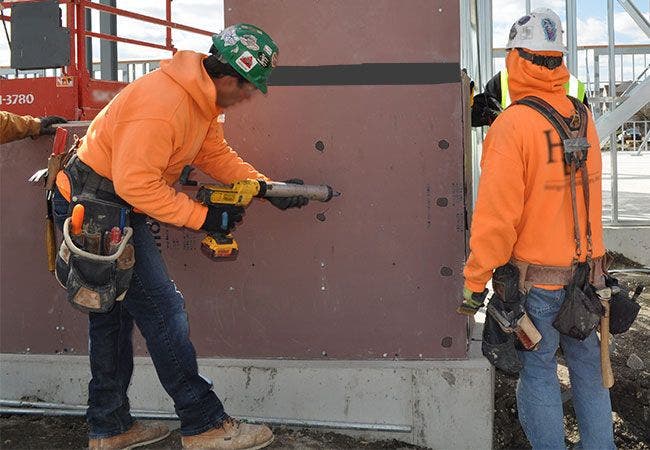
<br><b>DuPont™ LiquidArmor™ FJ Flashing and Joint Compound</b> is a brush or trowel-applied, vapor-permeable elastomeric flashing material. It combines the functions of both flashing and joint compound into a single unique product that is an integral part of the <b>DuPont™ ArmorWall™ System</b>.
Resources
Product Information Sheets Installation Guides Technical Documents Safety Data Sheets CAD Detail Set
Features & Benefits
High Performance Durability
- The single component, silyl-terminated polyether (STPE) formulation of DuPont™ LiquidArmor™ FJ is not water-soluble and will not lose physical properties or wash off the wall when exposed to liquid water, even before curing.
- Passes AAMA 714, Specification for Liquid Applied Flashing Used to Create a Water-Resistive Seal Around Exterior Wall Openings in Buildings.
- Excellent elasticity, with over 90% recovery at 300% elongation.
- Can be installed on damp surfaces, which is defined as when no moisture is transferred to the skin when the substrate is touched.
- LiquidArmor™ FJ may be exposed to UV for 270 days (9 months).
Air and Water Resistance
- Offers an ideal combination of air and water holdout along with vapor permeability.
- When installed as part of the DuPont™ ArmorWall™ System, passes assembly air leakage testing per ASTM E2357 and assembly water resistance testing up to 15 psf per ASTM E331.
Ease of Use
- High percent solids formulation - low shrinkage during curing, enabling single-coat application.
- Excellent gunnability, with easy tooling when minimum ambient and surface temperatures are 20 °F (-6.6 °C) and rising.
- Brushable and trowelable for fast and easy application.
Specifications
Standard Sizes
Testing
<b>DuPont™ LiquidArmor™ FJ</b> exhibits physical properties as indicated when tested as represented. Review all instructions and (Material) Safety Data Sheet ((M)SDS) before use. Please contact DuPont at 1-833-338-7668 when additional guidance is required for writing specifications that include this product
NOTE:- Test results shown represent averages. Individual results may vary either above or below averages due to normal manufacturing variations, while continuing to meet product specifications.
FAQ
What is the UV exposure limit for DuPont™ LiquidArmor™ FJ Flashing and Joint Compound?
LiquidArmor™ FJ may be exposed to UV for 270 days (9 months).
Can DuPont™ LiquidArmor™ FJ Flashing and Joint Compound be applied to damp surfaces?
LiquidArmor™ FJ can be applied to damp surfaces as long as there are not water droplets or a film of water on the surface.
Can DuPont™ LiquidArmor™ FJ Flashing and Joint Compound be used in window and door rough openings with the DuPont™ ArmorWall™ System?
LiquidArmor™ FJ sealant is approved for use in window and door rough openings with the windowsill treated in conformance with the ArmorWall™ System Installation Guide. This is subject to change as additional evaluations are completed. Installers may also use DuPont™ DuraGard™ WD Self-Adhered Flashing Tape in window and door rough openings with the ArmorWall™ System.
What is the theoretical coverage rate for DuPont™ LiquidArmor™ FJ Flashing and Joint Compound?
The theoretical coverage rate for a 20-ounce sausage of LiquidArmor™ FJ , when applied at 35 wet mils (+/- 5 mils) is:
2 inch wide......................36 lineal feet per sausage
3 inch wide......................24 lineal feet per sausage
6 inch wide......................12 lineal feet per sausage
How do I clean up tools after applying DuPont™ LiquidArmor™ FJ Flashing and Joint Compound?
Clean tools with mineral spirits, Naphtha, or citrus-based cleaners. DO NOT use water to clean tools. Please refer to installation guidelines located on the LiquidArmor™ FJ website.
What color is DuPont™ LiquidArmor™ FJ Flashing and Joint Compound?
LiquidArmor™ FJ Sealant is dark grey when applied and chemically cures to the same dark grey.
What are the approved storage conditions and temperatures for DuPont™ LiquidArmor™ FJ Flashing and Joint Compound?
LiquidArmor™ FJ should be stored in controlled conditions in a clean and relatively dry environment between 50⁰ to 80⁰ F (10⁰ to 27⁰ C). High temperatures and excessively high relative humidity may reduce the product shelf life.
What are the approved temperatures for applying DuPont™ LiquidArmor™ FJ Flashing and Joint Compound?
LiquidArmor™ FJ may be applied when substrate and ambient temperatures are above 20⁰ F (-6.6⁰ C) and rising. The substrate must not be covered with frost or ice. Do not install once the ambient or surface temperature exceeds 95⁰ F (35⁰ C).
What type of chemistry is DuPont™ LiquidArmor™ FJ Flashing and Joint Compound?
LiquidArmor™ FJ is a single component, vapor permeable, silyl-terminated polyether (STPE) flashing material that may be brush or trowel applied to joints and sheathing fasteners on the DuPont™ ArmorWall™ System.
What is the shelf life of individual sausages of DuPont™ LiquidArmor™ FJ Flashing and Joint Compound?
Sausages of LiquidArmor™ FJ have a 15-month shelf life beginning from the date of manufacture printed on the individual sausage tubes. The 15-month shelf life applies to LiquidArmor™ FJ that is stored in controlled conditions in a clean and relatively dry environment between 50⁰ to 80⁰ F (10⁰ to 27⁰ C). High temperatures and excessively high relative humidity may reduce the product shelf life.
What are the approved locations that DuPont™ LiquidArmor™ FJ Flashing and Joint Compound can be used in conjunction with DuPont™ ArmorWall™ System?
LiquidArmor™ FJ sealant is designed for use with the DuPont™ ArmorWall™ System. LiquidArmor™ FJ
sealant may be applied with a brush or trowel over panel joints as well as all sheathing fastener heads. Through wall penetrations may be sealed using LiquidArmor™ FJ sealant in conformance with the ArmorWall™ System Installation Guide. Can DuPont™ LiquidArmor™ FJ Flashing and Joint Compound be exposed to precipitation immediately after installation? (AW-FAQ-44)
LiquidArmor™ FJ is a moisture-cured, silyl-terminated polyether (STPE) product that is non-water soluble and not susceptible to freezing and/or wash off when exposed to precipitation. LiquidArmor™ FJ can be applied to damp surfaces if there are not water droplets or a film of water on the surface.
Is there a warranty with DuPont™ LiquidArmor™ FJ Flashing and Joint Compound?
LiquidArmor™ FJ is an approved accessory item within the DuPont™ ArmorWall™ System. When installed in accordance with the DuPont™ ArmorWall™ System Install
Guide, the project may be eligible for the DuPont™ ArmorWall™ System Components 10-Year Limited Warranty. How is DuPont™ LiquidArmor™ FJ Flashing and Joint Compound currently packaged?
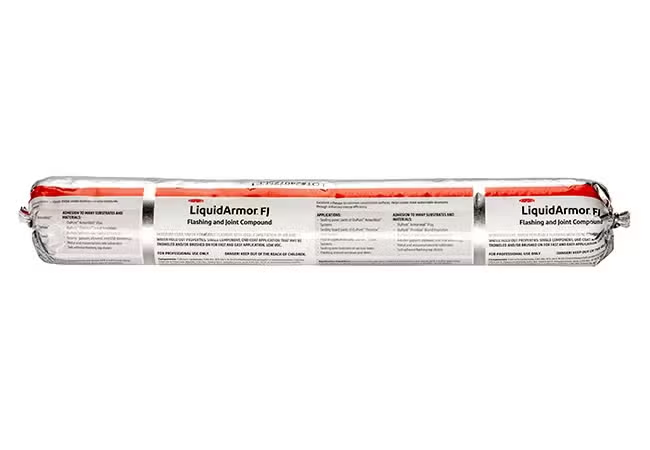
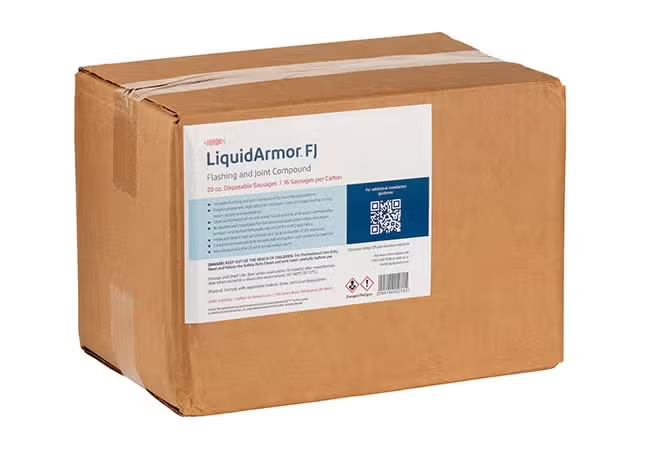
LiquidArmor™ FJ is packaged in 20-ounce sausages and are is shipped in a 16-pack carton.
What is the maximum in service temperature of DuPont™ LiquidArmor™ FJ Flashing and Joint Compound?
The maximum in service temperature of LiquidArmor™ FJ is 180⁰ F (82.2⁰ C).
What are the cure times for DuPont™ LiquidArmor™ FJ Flashing and Joint Compound?
•LiquidArmor™ FJ has an initial skin time of 1-2 hours at 70⁰ F (21⁰ C) and 50% RH. and It is resistant to minor abrasion and water penetration around fasteners after 24 hours.
• LiquidArmor™ FJ fully cures in approximately 14 days, depending on ambient conditions.
• LiquidArmor™ FJ can be covered by building wraps, additional continuous insulation, or exterior cladding materials after 48 hours have elapsed from initial installation, depending on ambient conditions.
What is the required mil thickness for DuPont™ LiquidArmor™ FJ Flashing and Joint Compound?
When applied over panel joints, panel fasteners, and through wall penetrations with the DuPont™ ArmorWall™ System, LiquidArmor™ FJ must be applied at 35 wet mils (+/- 5 mils).
Can DuPont™ LiquidArmor™ FJ Flashing and Joint Compound be exposed to precipitation immediately after installation? (AW-FAQ-43)
LiquidArmor™ FJ is a moisture-cured, silyl-terminated polyether (STPE) product that is non-water soluble and not susceptible to freezing and/or wash off when exposed to precipitation. LiquidArmor™ FJ can be applied to damp surfaces if there are not water droplets or a film of water on the surface.