Tyvek / DuPont™ Tyvek® 500 HP
TY178S HP
DuPont™ Tyvek® 500 HP
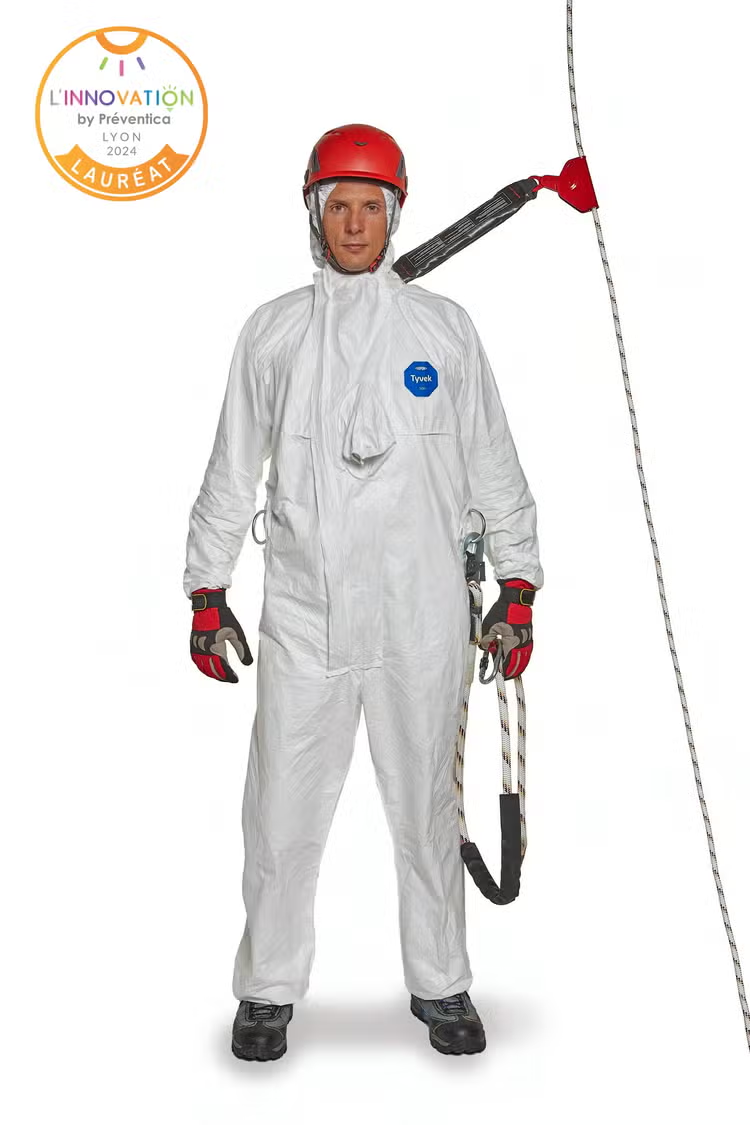
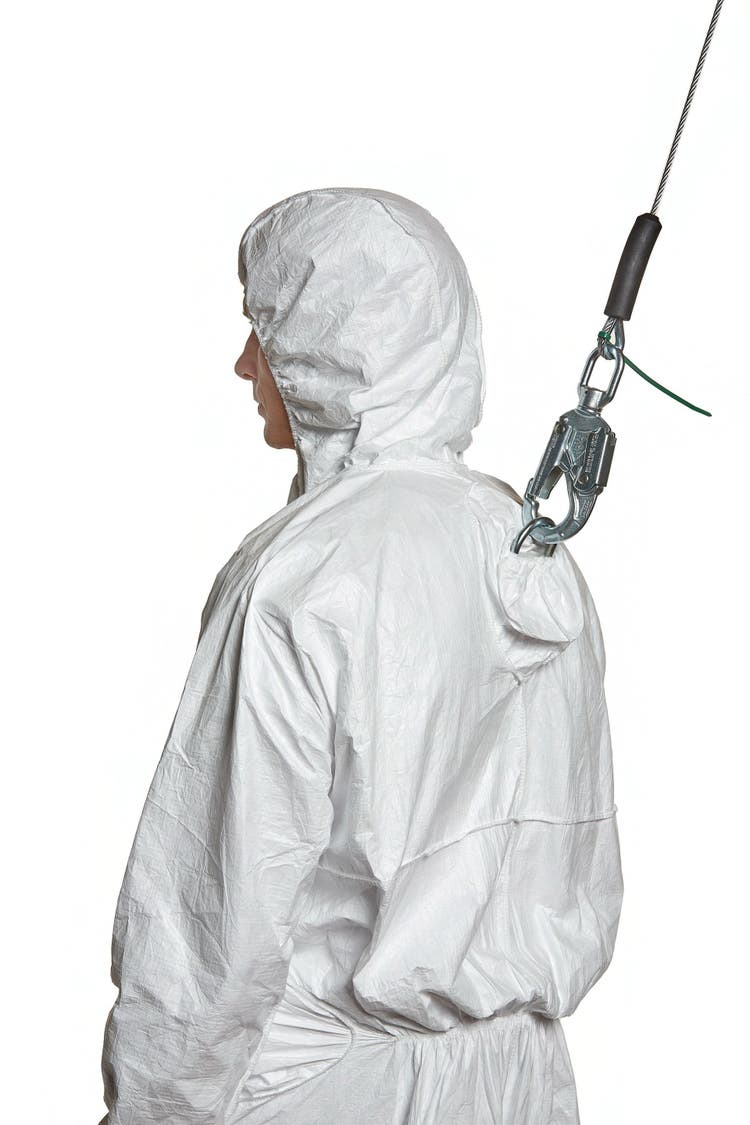
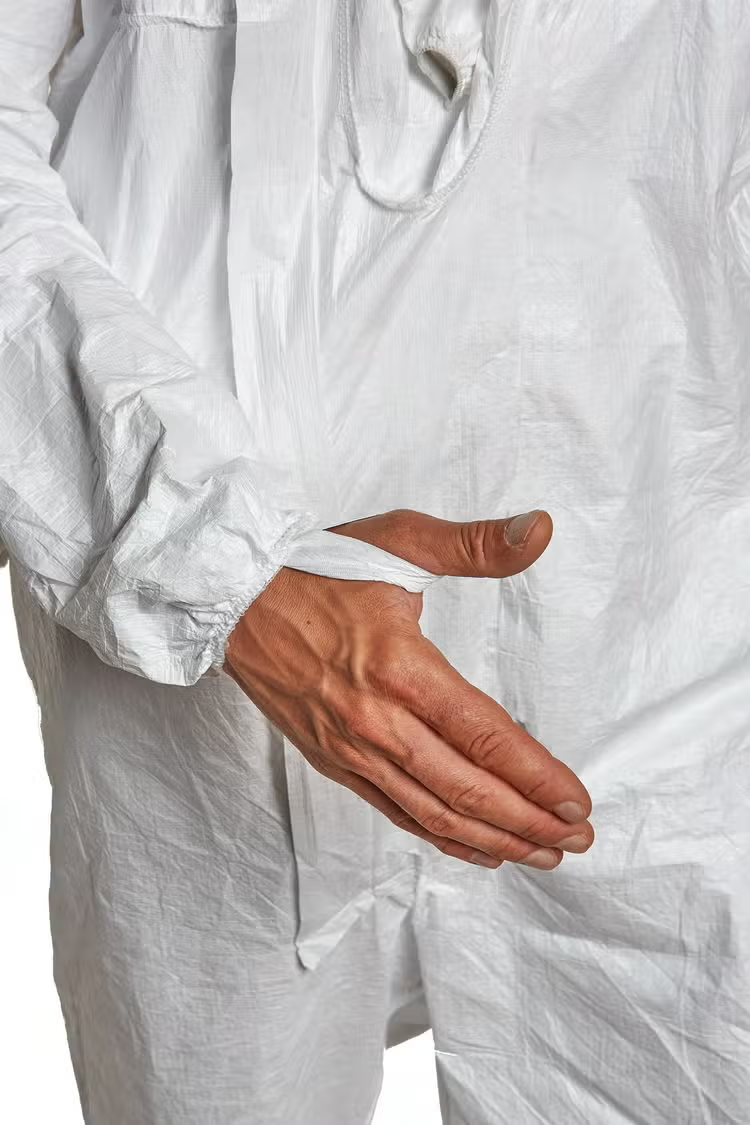
DuPont™ Tyvek® 500 HP (Harness Protection) Hooded Coverall with Four Attached D-Ring Sleeves. Designed to be worn over a full-body harness while protecting against fine particles and light liquid splash. White coverall features a patent pending ergonomic-protective design, multiple access points to the full-body harness (worn underneath the garment) through four elasticized D-Ring sleeves, an off-centered zipper entry to accommodate the front D-Ring sleeve, a 3-piece hood, elastic wrists, ankles, waist, and hood, thumb loops made of Tyvek® fabric, and a pin lock slider zipper pull. Suitable for a variety of applications, including cleaning, painting, and maintenance.
-
With Permeation Data
Without Permeation Data
-
DOUBLE CHECK Use Double Check to determine if this product is suitable for your hazard scenario.
-
Buy Now
Distributors in the United States
Authorized Wholesalers in the United States (Distributors Only)
Frequently Asked Questions
TY178S HP
DuPont™ Tyvek® 500 HP
Are Tyvek® garments low linting? Tyvek® fabric is low-linting by nature of its continuously strong, high-density polyethylene fibers. DuPont cannot guarantee the absence of particles on these garments as threads and zippers can be the most significant source of contamination. For end users with concerns about contamination or any other contaminants, the best practice is to audit in-bound materials, including garments, for those contaminants. End users with highly specialized requirements may consider Tyvek® IsoClean® garments for controlled environments designated as Clean-Processed (0C option): These garments are specially processed to minimize particle shedding and individually packaged in an ISO Class 4 cleanroom. Can Tyvek® 500 HP garments be recycled? Yes; in the United States, garments not contaminated with chemical or biological hazards can be recycled for non-hazardous applications through the Tyvek® Protective Apparel Recycling Program.Contact DuPont Personal Protection Customer Service at 1-800-931-3456 for information. Where can I find a SDS (Safety Data Sheet) for Tyvek® 500 HP garments? Safety Data Sheets (SDS) are written in accordance with applicable federal regulations, 29 CFR 1910.1200, to communicate health and safety data on usage and handling of hazardous chemicals. Under this regulation, DuPont™ Tyvek®, ProShield®, and Tychem® materials and garments are defined as articles, not chemicals, and the SDS and labeling requirements in that standard do not apply. Are Tyvek® 500 HP garments anti-static or static dissipative?
The fabric used to make Tyvek® 500 HP garments is treated with a topical antistatic agent to help minimize static build up and reduce nuisance garment cling.
In situations where static dissipation level is a critical performance property, end-users should evaluate the performance of their entire ensemble as worn including outer garments, inner garments, footwear and other PPE. In order for any garment system to be static dissipative, it must be able to drain a charge buildup through proper grounding devices, such as, but not limited to, workstation grounding clips or static-dissipative floors.
Under certain conditions, such as cold and dry weather, it is possible that garments might build and discharge static electricity. Discharges are not normally dangerous except in situations where the generation of an electrical spark could ignite a flammable atmosphere or startle the wearer. When operating around flammable chemicals, take steps to eliminate potential static discharges. In these situations, suggested steps include, but not limited to, water spray, the use of an overcover, raising humidity level of the work area, use of a commercial, anti-static application coating, grounding straps on equipment and personnel, inherently static-dissipating under- and over-garments, and testing of the worker's static dissipation before entry into the classified area.
However, in the case of explosive or flammable atmospheres, even if steps are taken to manage static formation and dissipate static charge, the risk of severe injury remains if an uncontrolled or accidental ignition occurs. Do not wear Tyvek® 500 HP chemical protective garments in potentially flammable or explosive atmospheres. Do not knowingly enter an environment in which the concentration of flammable gas is within flammable or explosive limits while wearing a Tyvek® 500 HP garment. If you determine that you are in a potentially flammable or explosive environment, retreat immediately. What full-body harness models is this garment compatible with? This garment has four elasticized access points: one to the front (on chest, i.e., sternal) D-Ring, one to the back (i.e., dorsal) D-Ring and one on each side to the side D-Rings on the full-body harness. These access points are called “D-Ring sleeves” and allow compatibility with a variety of full-body harness models. Do Tyvek® 500 HP garments meet ANSI/ISEA 101 sizing standards? No. DuPont Tyvek® 500 HP coveralls do not meet ASNI/ISEA 101 sizing standards. For specific sizing dimensions on a particular DuPont garment, please view the Product Details tab for that garment. How should Tyvek® 500 HP garments be stored? Store Tyvek® 500 HP garments in a cool, dark, dry location free of dirt and insects. Sunlight, ozone, high temperatures (>120° F ; 49° C), vehicle exhaust fumes, compression under heavy weights and sharp edges or projections are some conditions known to degrade the materials in these garments.Store Tyvek® 500 HP garments in boxes, in bags or on hangers. Never step on protective garments. Never place or store heavy objects on top of protective garments In what ways can I dispose of Tyvek® 500 HP garments? In the United States, if not contaminated, Tyvek® 500 HP garments can be recycled through the Tyvek® Protective Apparel Recycling Program.Contact DuPont Personal Protection Customer Service at 1-800-931-3456 for information.
Tyvek® 500 HP garments may be landfilled or incinerated in accordance with local regulations. Uncontaminated chemical protective garments may be incinerated in a facility that is capable of handling mixtures containing plastics. Likewise, an uncontaminated chemical protective garment may be buried in a facility that accepts plastic materials.
Contaminated garments that cannot be handled safely without protective equipment must be disposed of with other hazardous wastes, either through incineration or landfill per local regulations. Before discarding, cut off a sleeve or a leg so the garments cannot be worn again as protective clothing. What determines if the garment is contaminated ? The decision on whether or not a garment has been contaminated is made by local managers responsible for PPE based on an analysis of the incident in which the garment was used. This analysis may include exposure time, chemicals involved, level of exposure, proximity to the actual release, tasks performed and environmental monitoring in the area in which the garment was worn. Garments that are damaged, altered or show signs of contamination, such as discoloration, odor, stiffening or cracks, should not be used. Is it possible to wash and re-use Tyvek® 500 HP garments? DuPont does not recommend washing Tyvek® 500 HP garments for re-use. These garments are designed for limited-use. They can be worn until damaged, altered or contaminated. In what ways can I manage or prevent heat stress? Chemical protective clothing can interfere with the natural regulation of body temperature. This can lead to a rise in core body temperature and heat stress. Implementing a conservative work/rest schedule or using a cooling system may be effective in reducing heat stress. (Note: Do not wear cooling vests in potentially flammable or explosive environments.) .)
Be aware of the symptoms and treatment of heat stress. If you or your co-workers have symptoms of heat stress such as nausea, dizziness, high heart rates, or excessive heat build-up, leave the work area immediately and remove the ensemble as quickly as possible after decontamination and seek professional care.
The maximum length of time the chemical protective clothing can be worn depends on variables such as the air supply, ambient conditions, climate inside the ensemble, physical and psychological conditions of the wearer, work rate and work load. The TLV® pocket guide from the American Conference of Governmental Industrial Hygienists (ACGIH, Cincinnati) provides corrected heat stress limits for some garments. Similar information is available on the federal OSHA web site (www.OSHA.gov). The WBGT correction factor for chemical protective garments is at least 10°C or higher for chemical garments made of impervious films (such as Tychem® garments) and covering the entire body (hooded coverall or encapsulating designs). For Tyvek® coveralls, the WBGT correction factor is 2°C with a hood and 1°C without a hood. Are Tyvek® 500 HP garments flame resistant or flame retardant (FR)?
No, Tyvek® 500 HP garments are not flame resistant or flame retardant and should not be used around heat, flame, sparks or potentially flammable or explosive environments. Tyvek® 500 HP garments will ignite and continue to burn and melt.
In addition, Tyvek® 500 HP garments should not be worn under or over a garment made of Nomex® or any other flame resistant fabric, if the potential for fire or electric arc exists. Do Tyvek® 500 products contain silicone? All DuPont Personal Protection products are manufactured under specifications that do not contain silicone, with some exceptions. Tyvek® friction-coated shoe covers or Tyvek® garments with friction-coated shoe covers might contain silicone. This includes Tyvek® styles TY122, TY121, FC450 and FC454. Additionally, Tychem® 6000 AL styles TF630 and TF640T contain a silicone valve diaphragm. End users who are consuming these styles and who have concerns about silicone contamination should conduct their own testing to ensure they are suitable for their application(s). Do Tyvek® 500 products contain latex? As of January 2023, all DuPont Personal Protection products are manufactured under specifications that exclude components containing natural rubber latex. Tyvek® 500, Tyvek® 600 and Tyvek® 800 styles made before January 2023 contain natural rubber latex, which may cause allergic reactions in some sensitized individuals. Anyone who begins to exhibit an allergic response during the use of DuPont products should immediately cease using these products and should report it to DuPont at +1 (888) 439-2988 so that an investigation can be initiated. How should this garment be worn when used together with a full-body harness?
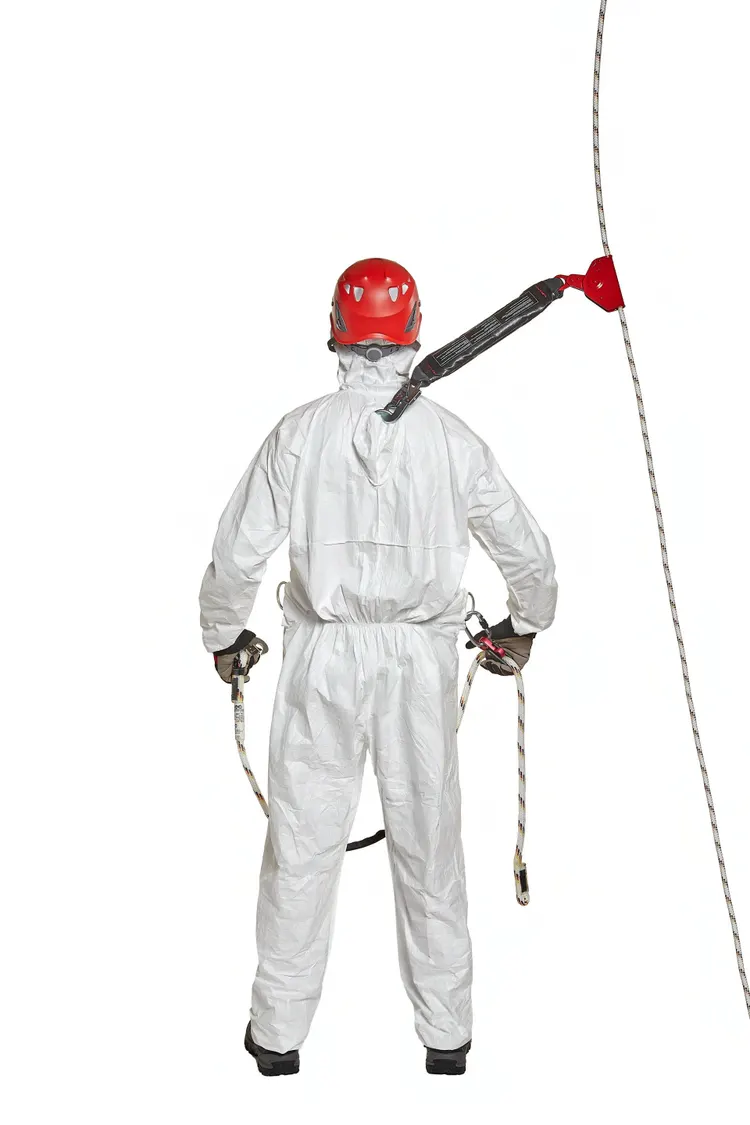
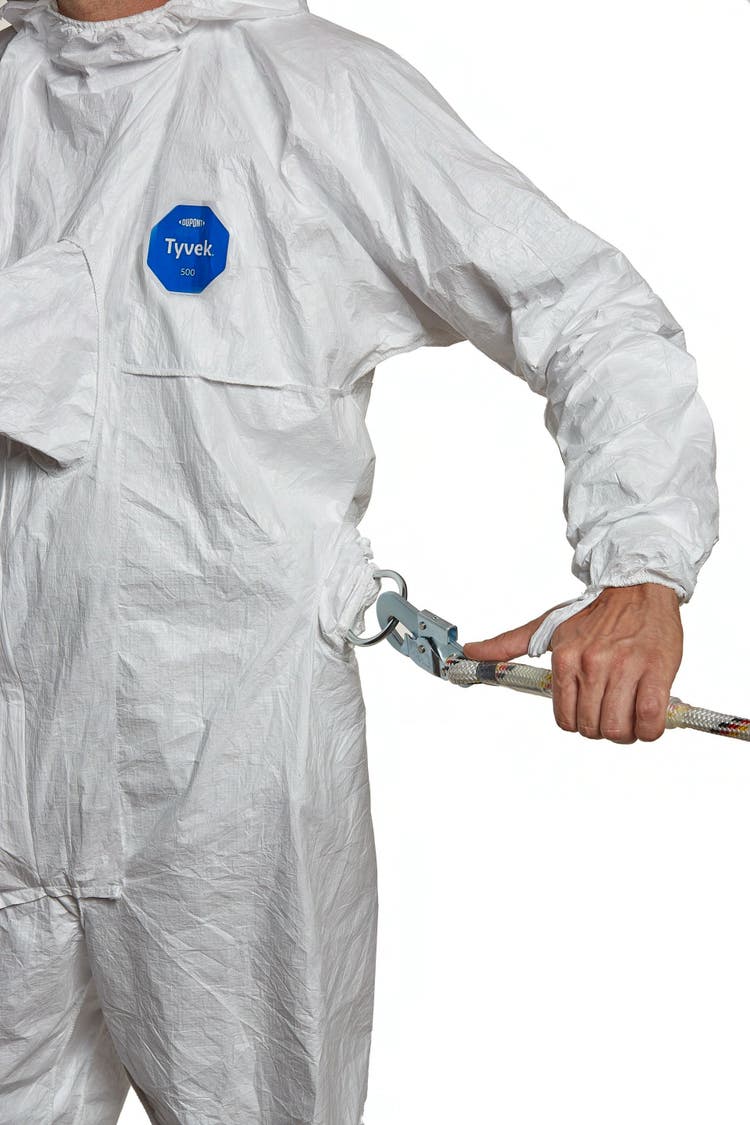
This garment is designed to help protect both the wearer and the full body harness that is worn underneath the garment, against contamination.* It can be used with or without the D-Ring sleeves in use. If the D-Ring sleeves are not in use, they shall remain outside of the garment facing downwards. When using the coverall in combination with a restraint or an appropriate fall arrest system, the suitable D-Ring sleeves – according to harness type and the work to be performed – must be used by pulling the appropriate D-Ring(s) through the coverall’s elastic D-Ring sleeve(s) so the D-Ring(s) is outside of the coverall. Under no circumstances shall any part of the fall arrester equipment (e.g. shock-absorber or retractable fall arrestor) and its connector elements be inside the coverall.
Dynamic Fall Testing with an articulated mannequin was performed at an independent testing laboratory as well as at a harness manufacturer with a conclusion that the Tyvek® 500 HP TY178S HP garment is not anticipated to affect the dynamic fall test performance of the full-body harness when worn underneath this garment. The test is successful as it demonstrated that the Tyvek® 500 HP TY178S HP garment is not impairing the proper function of the full-body harness in case of a fall.
*The user must ensure the garment is suitable for the chemical hazard before use. Please refer to chemical permeation data & CE certification available in SafeSPEC™ to help you understand the level of protection the garment offers. How are Tyvek® garments different from other limited-use garments on the market? Tyvek® garments are unique in several ways. First is the proprietary flash spun Tyvek® fabric which offers inherent breathable barrier that cannot easily be worn or abraded away. This inherent barrier of Tyvek® is not dependent on a thin film or a thin layer of small fibers -- with Tyvek®, every part of the fabric provides barrier. This delivers an effective breathable barrier to particles due to the torturous path created by this unique fabric structure. Unlike microporous film garments, the breathability of Tyvek® garments can be easily demonstrated. Watch this video to see for yourself. What is the shelf life of Tyvek® 500 HP garments? DuPont suggests that Tyvek® garments be used within 5 years of receipt, provided they are properly stored and pass a full visual inspection. High temperature, oxidizing gases, wet, cold, ultraviolet and ionizing radiation can significantly impact the long-term life of garments made of Tyvek®. The antistatic properties may reduce over time. The user must ensure the dissipative performance is sufficient for the application. What are the donning and doffing instructions for Tyvek® 500 HP coveralls?
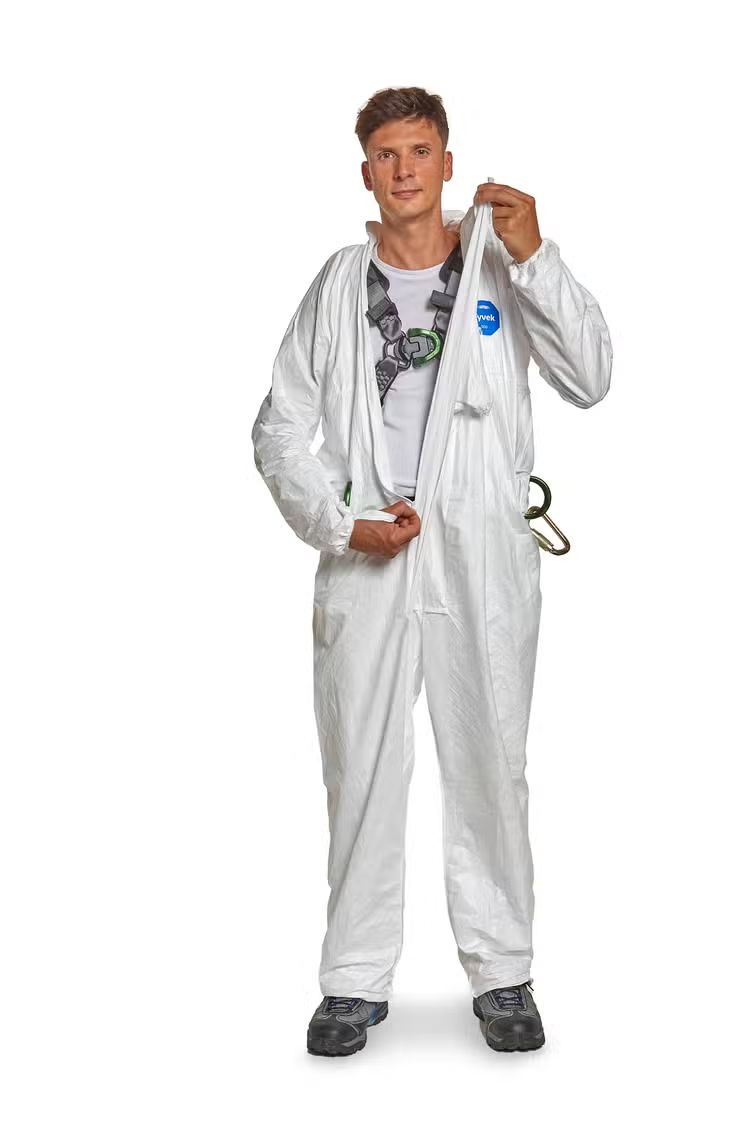
The Tyvek® 500 HP TY178S HP protective coverall is designed to be worn over a full-body harness. Use the D-Ring sleeve(s) applicable to your full body harness type and the work to be performed by pulling the appropriate D-Ring(s) through the coverall’s elastic D-Ring sleeve(s) so the D-Ring(s) is outside of the coverall. If the back D-Ring will be used, an assistant should support the donning/doffing process. Under no circumstances shall any part of the fall arrester equipment (e.g. shock-absorber or retractable fall arrestor) and its connector elements be inside the coverall.
For enhanced protection in certain applications, taping of cuffs, ankles, hood, zipper flap and D-Ring sleeves may be necessary. It is the user’s sole responsibility to choose the correct combination of coverall with any other additional PPE. If additional PPE is required (e.g. respiratory protection, hand protection, etc.), it should be donned/doffed during the coverall donning/doffing sequence according to the PPE manufacturer’s user instructions & the donning/doffing procedure defined by your HSE. It remains the sole responsibility of the user to ensure that the complete PPE system chosen is appropriate for the specific application.
Please refer to the Tyvek® 500 HP TY178S HP Donningand Doffing video demonstrations for more details. What are Type 4/5/6 garment standards? Chemical protective clothing certified to a specific Type can have very different performance properties in terms of protection, durability and comfort. The indicated Type simply means that the suit has passed one or more of the whole suit liquid tests and meets the minimum performance requirements for the constituent mechanical and barrier tests. Click to View - Preparing for ISO 16602 PDF
DUPONT™ SAFESPEC™ Terms of Use
Product Selector Agreement
The following information must be read and accepted by the user before proceeding.
The DuPont™ SafeSPEC™ Product Selector Tool (“Tool”) is intended to assist in choosing protective clothing styles for particular applications and does not replace the judgment of a qualified safety professional or industrial hygienist. Additional personal protective equipment (“PPE”), such as but not limited to: respiratory, eye, head, foot, and hand protection, may be required. Supplying the proper hazard/chemical and exposure information for your hazard scenario is critical in order to obtain suggestions of possible garment options for your consideration. Inaccurate information could result in improper suggestions. Since there are other factors involved which could affect the final PPE decision and may not be considered in this Tool, the final decision on protective clothing selection is the responsibility of the buyer, safety professional, industrial hygienist and end-user. DuPont de Nemours, Inc. or its affiliates DISCLAIM ANY RESPONSIBILITY OR LIABILITY FOR ANY INFORMATION OR SUGGESTIONS PROVIDED BY THE TOOL OR THE USE THEREOF.
WARNING / CAUTION
There are uses, environments and chemicals for which any garment will be unsuitable. It is the responsibility of the user to review available data and verify that the garment selected is appropriate for the intended use and meets all specified government and industry standards.
Search by :
1 Choose Hazards
1 Enter
Chemicals
2 View Permeation Data
2 View
Data
3 View Matching Products
3 View
Products
Step 1 of 3
You may enter from one to five chemicals or other hazards that may be present in your working environment. Our tool will find the best product match for the combined hazards. Enter a single chemical or hazard if you wish to find the best possible product match for that one hazard.
Chemical or Other Hazard Name
Enter at least 3 characters and select hazard from list.
or
CAS Number
Synonyms, Class and Sub-Class information
Hazard Concentration information
Please read following
- You have selected a chemical that has been tested at multiple concentrations. All concentrations will be displayed on the next page so that you can review breakthrough times for each concentration.
- Please review FAQs if your hazard concentration is lower or higher than the tested concentrations
Read FAQ if your Hazard concentration is lower than the tested concentration Read FAQ if your Hazard concentration is higher than the tested concentration
Need Help?
- If you see your CAS number in the drop down list, make sure you are selecting the hazard from the drop down list before clicking "Add to List".
- If you do not see your CAS number listed, check the number and try again or you may want to try Guide.
1 Choose Hazards
1 Enter
Chemicals
2 View Permeation Data
2 View
Data
3 View Matching Products
3 View
Products
Step 2 of 3
CHEMICAL COMPARISON
The table below shows the Normalized Breakthrough times of fabrics for the hazards selected. (Testing Details) You can find specific garments that protect against these hazards by clicking the 'Next' button below.
Done
btAct
Done
btAct
Done
<< BACK TO CHEMICAL LIST
1 Choose Hazards
1 Enter
Chemicals
2 View Permeation Data
2 View
Data
3 View Matching Products
3 View
Products
Step 3 of 3
Exposure
Please provide a response to all exposure questions before proceeding.
Flammable Environments
WARNING
If any of the following apply:
- A fire or electric arc is actively present in the work environment
- The work environment contains an uncontrollable flammable material between the Lower Explosive Limit (LEL) or Lower Flammable Limit (LFL) and the Upper Explosive Limit (UEL) or Upper Flammable Limit (UFL)
- The work environment has been subject to a breach or loss in containment of flammable material (flammable liquids, flammable vapors or combustible dusts)
- There is an uncontrolled fuel source available in the work environment (that may or may not have encountered an ignition source yet)
STOP USING THIS TOOL. Please consider fire fighter PPE (personal protective equipment). Read more.
If none of these conditions apply but FR clothing is required in your working environment, close this box and proceed to the next question. Only fabrics that provide both chemical resistance to the hazards you have listed and protection during escape from a flash fire will be considered for your hazard scenario.
1 Choose Hazards
1 Enter
Chemicals
2 View Permeation Data
2 View
Data
3 View Matching Products
3 View
Products
step3of3
 Is Suitable For Hazard Scenario
Is Not Suitable For Hazard Scenario
Compare All
YOU MAY WANT TO CONSIDER SIMILAR PRODUCTS RELATED TO TY178S HP
Matching Products (0)
Your hazard scenario did not produce any results. May we suggest:
- If you are searching multiple hazards at one time, try breaking your search into separate hazards by either creating a new scenario or unchecking Hazards in the pane to the left. SafeSPEC™ is trying to find one garment that can be used for all of your hazards. You may need to consider more than one garment.
- If you have a liquid or vapor chemical hazard, try searching the Chemical Resistance Database. This database will show you permeation data for all of the fabrics tested against a given hazard. Once you are able to determine a suitable fabric, you will have the flexibility of selecting a suitable garment design and seam construction yourself.
- If you answered "yes" to the question that you are working in an environment that requires flame resistant clothing, please note that although DuPont has several garment options for scenarios involving possible industrial fire or electric arc exposures as well as chemical exposure hazards, these garments may not have been tested against the specific chemical hazard(s) that you have selected or may have breakthrough times lower than your intended work duration. If possible, try to mitigate the need for flame resistant clothing by implementing engineering controls, work practices and administrative controls before resorting to protective clothing. Additionally, try breaking your search into separate hazards as suggested above in order to find garment options to meet your needs.
- If you selected "localized to the feet" for the direction of exposure question, you may want to consider chemical resistant boots instead of purchasing a full garment. DuPont does not manufacture or sell chemical resistant boots. However, we do offer some coveralls and encapsulated suits with attached socks. These socks can be worn as an extra layer of protection inside of chemical resistant boots.
If you still need help, please Contact Us.
For a general fabric overview, please view our
SELECT FROM SAVED SCENARIO
Please select the Scenario you have saved for the
Saved Scenario for
Is Suitable For Hazard Scenario
Is Not Suitable For Hazard Scenario
Compare All
YOU MAY WANT TO CONSIDER SIMILAR PRODUCTS RELATED TO TY178S HP
For a general fabric overview, please view our
Hazards Matrix
Hover over image to zoom
Technical Data Sheet
FEATURES & PRODUCT DETAILS
Workers operating with a full-body harness in environments where hazardous particle or light liquid aerosol hazards are present, previously had to compromise between efficient personal protection* and protecting their full-body harness against external contamination.The new Tyvek® 500 HP TY178S HP garment offers a unique solution – protection of both the wearer and the full-body harness – by providing a barrier between the user and the particle or light liquid aerosol hazards* in the environment. Designed to be worn over a full-body harness, the innovative, patent-pending garment design allows workers to access and utilize multiple D-Rings on their full-body harness while providing an ideal balance of protection, durability, and comfort. This new TY178S HP model has four attached sleeves for use with front, back and side D-Rings of a full-body harness. The off-centered zipper entry allows accommodating the front D-Ring sleeve for front D-Ring connection. *The user must ensure the garment is suitable for the chemical hazard before use. Please refer to chemical permeation data available in SafeSPEC™ to help you understand the level of protection the garment offers.
Compatible with a variety of full-body harness models, this garment may be used for a wide range of applications including painting, cleaning, maintenance, and more.
- Innovative, patent-pending design for applications where full-body harness is worn; garment is designed to be worn over the full-body harness
- Multiple access points to the full-body harness through the four elasticized D-Ring sleeves that are attached to the garment – one in the front, one in the back, and one on each side of the garment
- Off-centered zipper entry to accommodate the front D-Ring sleeve for front D-Ring connection
- Certified according to Regulation (EU) 2016/425.
- Chemical protective clothing, Category III, Type 5-B and 6-B
- EN 14126 (barrier to infective agents), EN 1073-2 (protection against radioactive contamination)..
- Antistatic treatment (EN 1149-5) – on both sides of the fabric
- 3-piece hood with elastic face opening
- Stitched seams
- Tyvek® thumb loops
- Pin locking slider locks in place when the pins on the puller are pushed into the zipper elements
- Tyvek® storm flap
- Elasticated ankles & wrists and elasticated (glued-in) waist
- Ample crotch area
- Manufactured under specifications that do not contain silicone or silicone oils
- Dynamic Fall Test with an articulated mannequin – Tested in an independent testing laboratory as well as at a harness manufacturer with a conclusion that the Tyvek® 500 HP TY178S HP garment is not anticipated to affect the dynamic fall test performance of the full-body harness when worn underneath this garment. The test is successful as it demonstrated that the Tyvek® 500 HP TY178S HP garment is not impairing the proper function of the full-body harness in case of a fall.
ADDITIONAL EQUIPMENT NEEDED
- This coverall is not part of a restraint system or fall arrest system. It does not protect the user against hazards of a fall or in the event of a fall. This coverall is designed to be worn over top of a full body harness and provide access via the D-ring sleeves to multiple attachment points on the harness. It is the user’s sole responsibility to choose the correct combination of coverall with any other additional PPE. It remains the sole responsibility of the user to ensure that the complete PPE system chosen is appropriate for the specific application. The user must ensure that the complete chosen PPE system does not compromise the integrity or intended functionality of any part of the PPE system in use.
- Wear other appropriate PPE such as, but not limited to, respiratory, eye, head, hand, and foot protection based on the hazard assessment.
FINISHED DIMENSIONS
AVAILABLE OPTIONS
SPECIFICATIONS
- The garment shall be constructed of DuPont™ Tyvek® 500.
- The garment shall be white in color.
- The garment shall have stitched seams
- The garment shall have a 3-piece hood with elastic face opening.
- The garment shall have an off-centered front zipper closure with storm flap.
- The garment shall have elastic ankles and wrists.
- The garment shall be a coverall design.
- The garment shall have an elastic waist.
- The garment shall have thumb loops made of Tyvek® fabric.
- The garment shall have four elasticated D-Ring sleeves: one in the front, one in the back, and one on each side of the garment.
FABRIC & CHEMICAL RESISTANCE DATA
Physical Properties
Data relating to mechanical performance of the fabrics used in DuPont chemical protective clothing, listed for the selected garment according to the test methods and relevant European standard, if applicable. Such properties, including abrasion and flex-cracking resistance, tensile strength and puncture resistance can help in the assessment of protective performance.
Featured resources Download Permeation Guide
WARNING
- *This garment does not protect against ionizing radiation.
- *Serged and bound seams are degraded by some hazardous liquid chemicals, such as strong acids, and should not be worn when these chemicals are present.
- *Liquid barrier performance varies based on the amount of liquid that may get on the garment, the length of time the liquid is on the garment, applied pressure and certain physical properties of the liquid. Tyvek® 400, Tyvek® 400 D, ProShield®, ProShield® 10, ProShield® 60, Tyvek® 400 FC, and ProShield® 70 garments are not appropriate if during use they are getting wet (liquid is dripping or running, or it is wet to the touch) or if spotting is observed on skin or garments worn under the protective garment. Tyvek® 500 and Tyvek® 600 offer improved liquid barrier, but may not be appropriate if spotting is observed on the skin or garments worn under the protective garment. In applications where a higher liquid barrier is needed, consider Tychem® 2000 and Tychem® 4000 garments with taped seams.
- **Garments made using Tyvek® 400, Tyvek® 500, Tyvek® 600 and Tyvek® 800 fabrics will burn and possibly melt. None of these garments should be worn near heat, open flames, sparks or any other possible ignition source nor should they be worn in potentially explosive or flammable environments. If these garments do burn or melt while being worn, it may increase the severity of burn injuries even when worn over garments which are flame resistant, including, but not limited to, Nomex® IIIA or Nomex® Comfort garments.
- *CAUTION: This information is based upon technical data that DuPont believes to be reliable. It is subject to revision as additional knowledge and experience are gained. DuPont makes no guarantee of results and assumes no obligation or liability in connection with this information. It is the user's responsibility to determine the level of toxicity and the proper personal protective equipment needed. The information set forth herein reflects laboratory performance of fabrics, not complete garments, under controlled conditions. It is intended for informational use by persons having technical skill for evaluation under their specific end-use conditions, at their own discretion and risk. Anyone intending to use this information should first verify that the garment selected is suitable for the intended use. In many cases, seams and closures have shorter breakthrough times and higher permeation rates than the fabric. Please contact DuPont for specific data. If fabric becomes torn, abraded or punctured, or if seams or closures fail, or if attached gloves, visors, etc. are damaged, end user should discontinue use of garment to avoid potential exposure to chemical. Since conditions of use are outside our control, we make no warranties, express or implied, including, without limitation, no warranties of merchantability or fitness for a particular use and assume no liability in connection with any use of this information. This information is not intended as a license to operate under or a recommendation to infringe any patent or technical information of DuPont or others covering any material or its use.
CHEMICAL RESISTANCE
- BT0.1 Normalized breakthrough time at 0.1 µg/cm²/min [mins]
- CAS Chemical abstracts service registry number
- min Minute
- > Larger than
- < Smaller than
- imm Immediate (< 10 min)
- nm Not tested
- sat Saturated solution
- N/A Not Applicable
- na Not attained
- GPR grade General purpose reagent grade
- * Based on lowest single value
- 8 Actual breakthrough time; normalized breakthrough time is not available
- DOT5 Degradation after 5 min
- DOT30 Degradation after 30 min
- DOT60 Degradation after 60 min
- DOT240 Degradation after 240 min
- BT1383 Normalized breakthrough time at 0.1 µg/cm²/min [mins] acc. ASTM F1383
SPECIAL WARNINGS
- *Serged and bound seams are degraded by some hazardous liquid chemicals, such as strong acids, and should not be worn when these chemicals are present.
- *Liquid barrier performance varies based on the amount of liquid that may get on the garment, the length of time the liquid is on the garment, applied pressure and certain physical properties of the liquid. Tyvek®400, Tyvek® 400 D, ProShield®, ProShield® 10, ProShield® 60, Tyvek® 400 FC, and ProShield® 70 garments are not appropriate if during use they are getting wet (liquid is dripping or running, or it is wet to the touch) or if spotting is observed on skin or garments worn under the protective garment. Tyvek® 500 and Tyvek® 600 offer improved liquid barrier, but may not be appropriate if spotting is observed on the skin or garments worn under the protective garment. In applications where a higher liquid barrier is needed, consider Tychem® 2000 and Tychem® 4000 garments with taped seams.
- Tyvek® 500 products manufactured before January 2023 did contain natural rubber latex which may cause allergic reactions in some sensitized individuals. Anyone who begins to exhibit an allergic response during the use of DuPont products should immediately cease using these products. The incident should also be reported to DuPont at +1 (888) 439-2988 so that an investigation can be initiated.
- **Garments made using Tyvek® 400, Tyvek® 500, Tyvek® 600 and Tyvek® 800 fabrics will burn and possibly melt. None of these garments should be worn near heat, open flames, sparks or any other possible ignition source nor should they be worn in potentially explosive or flammable environments. If these garments do burn or melt while being worn, it may increase the severity of burn injuries even when worn over garments which are flame resistant, including, but not limited to, Nomex® IIIA or Nomex® Comfort garments.
- *CAUTION: This information is based upon technical data that DuPont believes to be reliable. It is subject to revision as additional knowledge and experience are gained. DuPont makes no guarantee of results and assumes no obligation or liability in connection with this information. It is the user's responsibility to determine the level of toxicity and the proper personal protective equipment needed. The information set forth herein reflects laboratory performance of fabrics, not complete garments, under controlled conditions. It is intended for informational use by persons having technical skill for evaluation under their specific end-use conditions, at their own discretion and risk. Anyone intending to use this information should first verify that the garment selected is suitable for the intended use. In many cases, seams and closures have shorter breakthrough times and higher permeation rates than the fabric. Please contact DuPont for specific data. If fabric becomes torn, abraded or punctured, or if seams or closures fail, or if attached gloves, visors, etc. are damaged, end user should discontinue use of garment to avoid potential exposure to chemical. Since conditions of use are outside our control, we make no warranties, express or implied, including, without limitation, no warranties of merchantability or fitness for a particular use and assume no liability in connection with any use of this information. This information is not intended as a license to operate under or a recommendation to infringe any patent or technical information of DuPont or others covering any material or its use.
Cellosolve® and Selexol™ are registered trademarks of Dow Chemicals Company. Skydrol® is a registered trademark of Solutia. - As of January 2023, all DuPont Personal Protection products are manufactured under specifications that exclude components containing natural rubber latex. Tyvek® 500, Tyvek® 600 and Tyvek® 800 styles made before January 2023 contain natural rubber latex, which may cause allergic reactions in some sensitized individuals. Anyone who begins to exhibit an allergic response during the use of DuPont products should immediately cease using these products and should report it to DuPont at +1 (888) 439-2988 so that an investigation can be initiated.
View by: View all resources ✕ ✕ To access secured content from DuPont Please Sign In or Sign Up below Sign In New User ? Sign Up