- Products
- Downloads
- FAQ
- Where to buy
- Australia Belgium (Belgique) – Français Belgium (België) – Nederlands Brazil (Brasil) Bulgaria (България) Canada – English Canada – Français China (中国) Czech Republic (Česká Republika) Denmark (Danmark) France Germany (Deutschland) Italy (Italia) Japan (日本) Korea (대한민국) Mexico (México) Netherlands (Nederland) New Zealand Poland (Polska) Romania (România) Spain (España) Turkey (Türkiye) United Kingdom & Ireland
Top 6 questions asked about rigid insulation
Article | January 8, 2018
Article Top 6 questions of rigid insulation Share
Top 6 questions asked about rigid insulation
We’ve curated below the most common questions asked about our top rigid insulation choices: THERMAX™ Polyiso Insulation and STYROFOAM™ XPS Insulation. With increased attention on resiliency and building code requirements of late, the most asked topics are about mildew, flame spread requirements, and how to material storage. Does it spark a question for you? Get in touch. Our building scientists want to help you succeed.
It’s possible some of you just need product specs, and that’s fine too. We’ve included those facts among the responses below.
1. How should THERMAX™ (ci) Exterior Insulation be stored?
We know a lot of you are using Dow’s continuous insulation for your projects and need them stored properly, which can be a difficult task without a little guidance. The following are recommendations when storing THERMAX™ ci exterior insulation:
- Do not leave THERMAX™ ci Exterior Insulation products exposed to direct sunlight for longer than 180 days.
- Store above standing water.
- Keep product tarped or covered to protect from weather.
- If possible store product indoors.
- If product does get wet, allow it to air dry before covering with exterior coverings.
- Foam boards are lightweight and loose boards can be blown around by wind. Weigh down loose boards until they are securely attached to the structure.
- For both indoor and outdoor storage adhere to all local building and fire codes. (References include National Fire Protection Association (NFPA) 230 - Standard for the Fire Protection of Storage, NFPA 13 - Installation of Sprinkler Systems and the applicable ICC International Code or Local Building Code).
Related question: How long can THERMAX™, TUFF-R™ and Super TUFF-R™ Polyiso Insulation be left exposed to the elements before being covered?
2. Will STYROFOAM™ Brand Extruded Polystyrene Foam Insulation products promote mold or mildew growth?
Mold and mildew are nuisances every architect wants to avoid. We understand that completely. They can grow wherever sufficient moisture, spores, optimal temperatures and nutrients are present. The key factor is moisture, which can be controlled by adhering to sound construction practices. To make matters worse, condensation can be a source of moisture and a potential contributor to mildew growth. Condensation may occur when water vapor permeates through the wall, cools and condenses on the first cold surface it encounters.
One of the ways to manage moisture is to add insulation such that the condensing surface is not inside the wall system. Walls constructed with proper construction techniques and using an appropriate thickness of insulating sheathing will:
- Keep the wall cavity warmer than non-insulating sheathings in cold weather
- Reduce water vapor penetration into the wall from the outside in warm weather
- Reduce air flow through the wall assembly
- Result in less of an opportunity for moisture to condense within the wall
- STYROFOAM™ Brand Extruded Polystyrene Foam Insulation products and Dow polyisocyanurate foam insulation products help reduce moisture condensation and infiltration, thereby reducing the potential for mold growth.
STYROFOAM™ Brand Extruded Polystyrene Foam Insulation products and Dow polyisocyanurate foam insulation products are not expected to provide a nutrient source for mold. They resist moisture absorption in the insulation itself. This further reduce the potential for mold and mildew growth.
To be clear, no building assembly is likely to be completely free from the potential for mold formation, but good building practices unrelated to insulated sheathing will further reduce the potential or mold formation. Ultimately, good construction detailing, compliance with proper installation guidelines for materials, and maintenance of the wall system are key to managing the moisture infiltration into the building envelope.
3. What are the flame spread rating requirements for foam plastic insulation used in Canadian construction?
You’ll be glad to know residential requirements for flame spread ratings are easy – there are none. For commercial construction, however, the flame spread rating should be less than 500 according to CAN/ULC S102.2 (for thermal plastic materials) or CAN/ULC S102 (for thermoset materials).
Use our self-guided Canadian Code Assessment Engine to compare above grade wall strategies for building materials and design methods aligned to local code requirements. Try it today.
4. What are the effective system R-values for the THERMAX™ Wall System?
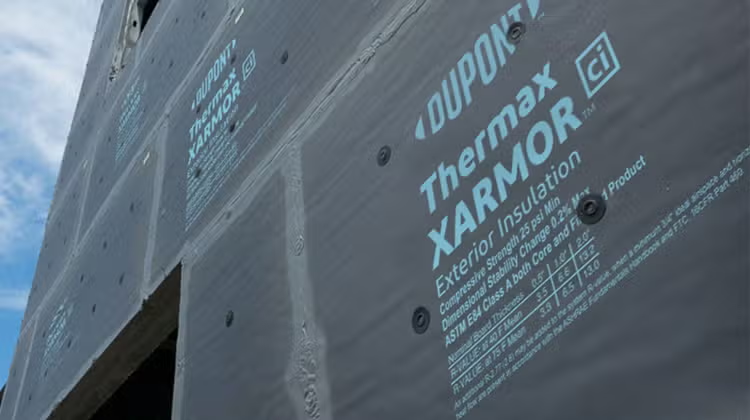
The quick answer is: it depends. The effective system R-value for the THERMAX™ Wall System is determined based upon the thickness of THERMAX™ ci Exterior insulation, the thickness of the STYROFOAM™ SPF (up to 1.5 inches) and, to a much smaller extent, the type of veneer. The table below outlines the effective system R-values for various thickness of THERMAX™ ci Exterior insulation with a veneer of stucco.
It’s important to know that the stucco veneer with a brick rain screen veneer will increase each R-value by about 1.7 Rs (assuming an R of 1.0 for the non-reflective air space and 0.7 for the brick veneer minus the stucco). However, Terra cotta, metal panel and fiber cement siding veneers will probably not appreciably increase the R-value of the system.
Our building science experts can perform a customized cost-to-build and performance analysis of your assembly to ensure the building envelope of your project is optimized. Request a report today.
5. What are the densities of STYROFOAM™ Extruded Polystyrene Foam Insulation products?
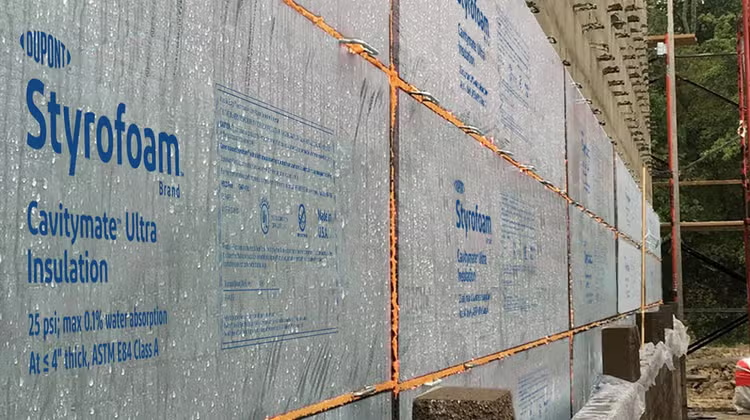
STYROFOAM™ Extruded Foam Polystyrene Insulation products are manufactured to conform to ASTM C578 standards, which require specific minimum densities. We’ve listed some examples below:
Type X with minimum density of 1.30 pcf
- STYROFOAM™ CAVITYMATE™ Insulation
- STYROFOAM™ Residential Sheathing (RS)
- STYROFOAM™ Z-MATE™ Insulation
Type IV with minimum density of1.55 pcf
- STYROFOAM™ CAVITYMATE™ Plus Insulation
- STYROFOAM™ CAVITYMATE™ Ultra Insulation
- STYROFOAM™ DECKMATE™ Plus Insulation
- STYROFOAM™ SCOREBOARD™ Insulation
- STYROFOAM™ Square Edge Insulation
- STYROFOAM™ Tongue and Groove Insulation
Type VI with minimum density of 1.80 pcf
- STYROFOAM™ HIGHLOAD 40 Insulation
- STYROFOAM™ ROOFMATE™ Insulation
Type VII with minimum density of 2.20 pcf
- STYROFOAM™ HIGHLOAD 60 Insulation
- STYROFOAM™ PLAZAMATE™ Insulation
Type V with minimum density of 3.00 pcf
- STYROFOAM™ HIGHLOAD 100 Insulation
As architects have likely heard, density is sometimes used to select a rigid foam insulation material for a particular application. It should be noted that there are other performance properties listed in ASTM C578 that are often more important to consider when choosing the proper product for an intended application.
Looking at Canada in particular, extruded polystyrene insulation products are covered by the standard ULC S701, which does NOT specify a density requirement.
6. How much do THERMAX™ Polyisocyanurate Insulation products weigh?
While that’s a hard question to answer completely, we’ve listed weights below for reference only. There may be variances among boards. All the weights are for boards of 1" thickness (1' x 1' square).
To get weight of 1-inch x 4 feet x 8 feet board multiple the value in table by 32. Example- Thermax Light Duty 1-inch x 4ft x 8ft weighs ( 0.197 x 32) = 6.3 lbs.


Share PBS Home Products Contact Us Locator Tools Sitemap Follow DuPont PBS Follow Tyvek® Construction Legal Notices & Terms of Use Privacy
© 2022 DuPont de Nemours, Inc. All rights reserved. DuPont™, the DuPont Oval Logo, and all products, unless otherwise noted, denoted with ™, ℠ or ® are trademarks, service marks or registered trademarks of affiliates of DuPont de Nemours, Inc.